

How to Simplify Motion Control by Eliminating the Traditional Control Panel
Quick Answer
Motion control can be simplified by eliminating the traditional control panel when motion, logic, I/O, safety, and communications are integrated into a single platform and distributed closer to the machine. This approach reduces hardware, wiring, engineering time, and long-term system complexity.
What Is a Traditional Motion Control Panel?
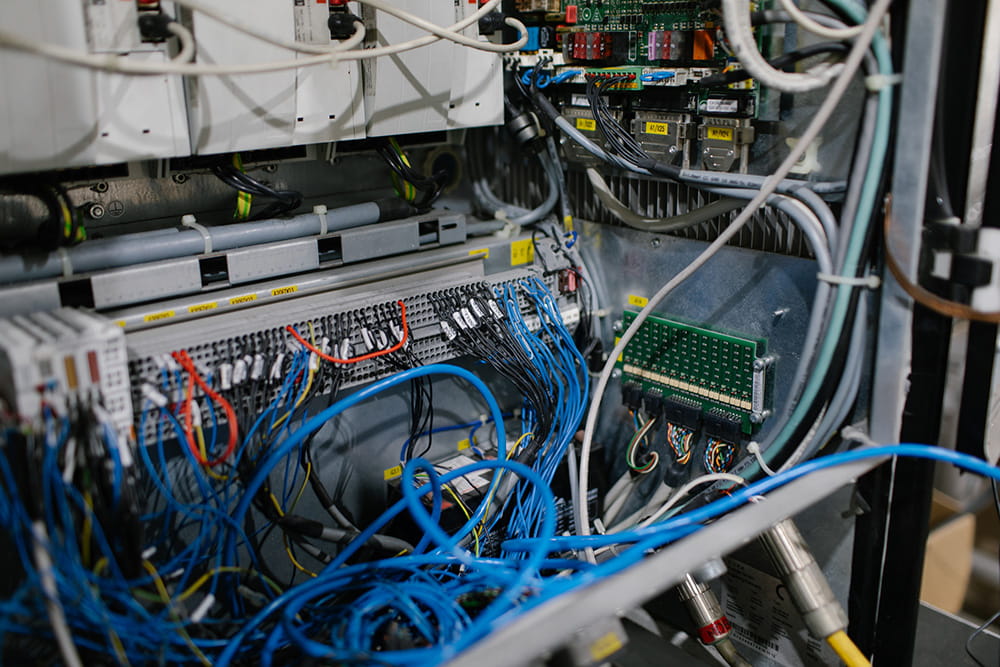
A traditional motion control panel is a centralized enclosure that typically contains:
- A PLC for logic and sequencing
- Servo drives for motor control
- I/O modules for sensors and outputs\
- Safety components wired separately
- Power supplies and extensive wiring
- Terminal blocks
This layout became the norm long before integrated motion platforms were practical.
Why Traditional Control Panels Became the Standard
Traditional control panels became the standard long before modern motion platforms existed, driven largely by practical constraints rather than architectural preference.
Early control systems evolved from hardwired relay-based logic, where components were large, discrete, and physically fragile. As electronic controls replaced relays, early PLCs and motion hardware still required significant protection from vibration, dust, moisture, and electrical noise. Mounting these components directly on machines was often impractical or unreliable.
Centralized enclosures provided a controlled environment to protect sensitive electronics while keeping wiring organized and serviceable. As motion control evolved, key functions were also delivered by different manufacturers. PLCs handled logic, servo drives handled motor control, and safety systems were implemented using separate hardware. Bringing these disparate components together inside a control panel was the most practical way to make them work as a system.
As machines grew more complex, control panels expanded accordingly. Additional devices, more wiring, specialized cabling, terminal blocks, and detailed documentation were required to connect sensors, actuators, and drives back to the centralized enclosure. Over time, this approach became the default not because it was simple, but because it was the most reliable way to build and protect increasingly sophisticated control systems with the technology available at the time.
What Changed in Modern Motion Control Architecture
The most significant change in motion control architecture lies in where intelligence lives.
Historically, core motion functions were distributed across multiple hardware components. PLCs handled logic. Servo drives handled power electronics. Safety systems were separate. Communication modules were added as needed.
Modern motion platforms are now available that integrate these functions into compact, machine-mounted devices rather than centralizing them inside a large control cabinet.
This shift means:
- Fewer separate hardware layers
- Reduced inter-device wiring
- Shorter signal paths between control and motion
- Less reliance on centralized panel-based architectures
Instead of building motion systems by assembling separate subsystems, modern platforms consolidate motion intelligence into integrated modules mounted closer to the machine.
How Does InoWorx® Eliminate the Traditional Control Panel?
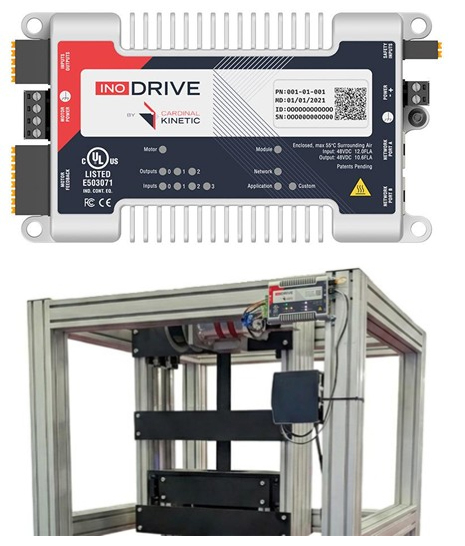
The InoWorx Motion Control Platform is built around an integrated, distributed architecture.
At the center of the platform is the InoDrive® module, which combines in a single device:
- Servo amplification
- Motion control
- Logic execution
- Configurable I/O
- Integrated safety, including STO
- Ethernet communications
By consolidating these capabilities into a compact, machine-level device, InoWorx reduces the need for a centralized PLC and large control cabinet in many machine designs.
InoWorx moves motion intelligence closer to the machine instead of residing in a remote enclosure, reducing wiring complexity, noise, and performance issues, and simplifying overall system architecture.
Does Eliminating the Control Panel Mean Eliminating the PLC?
Not always.
Eliminating the traditional control panel does not mean PLCs disappear everywhere. It means a PLC is not mandatory for many motion applications.
For compact machines, modular systems, and retrofit projects, an integrated motion platform can replace the need for a centralized PLC and cabinet. For highly complex systems, PLCs may still play a role, depending on the system's requirements.
Do You Need Ladder Logic to Control Motion?
No.
The InoWorx motion system is configured using a visual drag-and-drop environment rather than ladder logic. Motion sequences, automation workflows, and configuration changes can be created and adjusted without writing code.
This reduces training requirements, shortens development cycles, and makes motion control more accessible to a broader range of teams.
What Are the Practical Benefits of Eliminating the Control Panel?
Eliminating the traditional control panel delivers practical, system-level benefits:
Reduced hardware and wiring
- Fewer devices
- Fewer connections
- Fewer failure points
Smaller machine footprint
- No large cabinet required
- Easier integration into space-constrained designs
Faster deployment
- Less wiring and panel build time
- Simplified installation and commissioning
Lower total cost of ownership
- Fewer components
- Fewer software licenses
- Reduced long-term support effort
Easier expansion
- Additional motion axes added with modules
- No need to redesign the control architecture
When Does Eliminating the Traditional Control Panel Make Sense?
A simplified motion architecture is especially well-suited for:
- Compact or modular machines
- Retrofit projects replacing obsolete controls
- Applications where fast deployment matters
- OEMs looking to reduce engineering overhead
It is an architectural choice, not a one-size-fits-all rule.
Summary for Engineers and Decision Makers
-
Eliminating the traditional control panel simplifies motion control by integrating key functions into a single platform and distributing intelligence closer to the machine.
-
Instead of managing complexity through wiring, software layers, and cabinet design, this approach reduces complexity at the system level from the start.
Frequently Asked Questions
Evaluating a Simpler Motion Control Architecture?
If you are evaluating a new machine design or planning a retrofit and want to understand whether a panel-free motion architecture makes sense, let’s have a short architecture discussion to help you get clarity.