

Look Around. No PLC: Rethinking the Traditional Motion Control Architecture
Quick Answer
A programmable logic controller is not required for every motion application.
The InoWorx® Motion Control Platform combines motor control, motion logic, I/O processing, and communications in a distributed architecture that places intelligence closer to the machine. In appropriately scoped applications, this can eliminate the need for a separate PLC and traditional centralized motion-control panel.
In larger systems, a PLC can still be used for high-level coordination while InoWorx executes the motion locally.
The objective is not to eliminate PLCs indiscriminately. It is to use a PLC only where it adds value instead of treating it as a requirement for every motion function.
A Message That Started Conversations
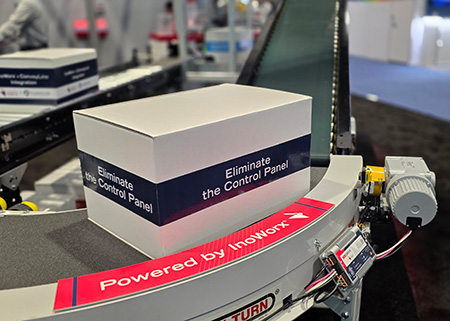
At Automate 2026, three messages at the Cardinal Kinetic booth consistently started conversations:
"No Control Panel Required."
"Look Around. No PLC."
"Eliminate the Control Panel."
Attendees did exactly what the messaging invited them to do. They looked at the demonstration, saw sophisticated motion taking place, and noticed what was missing.
There was no PLC controlling the application. There was no traditional centralized motion-control panel required to make the system operate.
That raised an understandable question: If motion can be controlled without the architecture engineers have relied on for decades, why are PLCs and control panels still treated as the default?
The answer is not that PLCs are obsolete. PLCs remain powerful and highly flexible industrial control tools. But the ability to use a PLC does not necessarily mean every motion application requires one.
Why PLCs Became the Default
PLCs became foundational to industrial automation for good reasons.
They can be configured to control motors, sensors, safety devices, communications, production sequences, process equipment, and large numbers of inputs and outputs. For engineers and integrators who must be prepared to solve many different automation challenges, that flexibility is valuable.
A PLC can be part of a system designed to do almost anything.
But designing a tool that can do almost anything also introduces complexity. A traditional centralized motion-control architecture may include:
- A PLC
- Motion-control modules
- Servo drives or variable frequency drives
- Input and output modules
- Communication hardware
- Power-distribution components
- Extensive field wiring
- A control enclosure
- Custom programming and integration
That architecture may be appropriate for a large, complex machine. It may be less appropriate when the objective is to control a relatively contained motion function.
When a lift, incline, turntable, indexing mechanism, or synchronized movement requires its own PLC logic, drive hardware, programming, and panel infrastructure, the control system can become more complicated than the motion task itself.
Operating Without a PLC Is the Proof
Operating without a PLC is not the product. It is the proof.
It demonstrates that InoWorx can execute sophisticated motion without depending on a PLC to calculate and control every movement.
The InoWorx platform combines intelligent InoDrive® hardware with software-defined motion control. Logic, motion profiles, inputs, outputs, and motor-control functions can be managed locally, close to the machine.
Depending on the application, InoWorx can control:
- Motor speed
- Position
- Torque
- Acceleration and deceleration
- Inputs and outputs
- Motion sequences
- Multiple coordinated axes
Instead of sending every signal back to a central PLC and waiting for the PLC to determine what the motor should do next, the local controller can execute the required movement directly.
Distributed motion control should not be confused with building an improvised control system from unrelated components. InoWorx is designed as an integrated industrial motion-control platform in which the hardware, programming environment, communications, and coordinated-motion capabilities operate together as a system.
That changes the role of the overall control architecture.
Move the Intelligence Closer to the Motion
In a traditional centralized system, sensors and motors may be wired back to a control panel. The PLC processes the inputs, executes the program, and sends commands back to the drives and motors.
In a distributed architecture, more of that intelligence resides near the equipment.
This idea is already familiar in material handling. Motorized drive roller, or MDR, technology is commonly used in conveyor systems and have helped move conveyor control away from a single central drive and toward smaller, independently controlled zones. Each zone can manage its own basic conveyor function while exchanging information with neighboring zones or a higher-level control system.
The same basic architectural principle can be applied to other types of motion.
The local controller understands the motion function it is responsible for performing. It receives the appropriate command, executes the movement, monitors feedback, and communicates status to the rest of the system.
This can reduce the amount of detailed motion logic that must be written into a central PLC program.
The central system does not necessarily need to calculate every acceleration profile, monitor every step of a movement, or command every motor start and stop. It may only need to communicate the desired outcome.
For example:
- Move the lift to position three.
- Rotate the turntable 90 degrees.
- Start the incline.
- Index the product forward.
- Synchronize these two motors.
- Send the package to the next destination.
InoWorx manages how the movement is executed.
Material Handling Has Already Made This TransitionThe shift from centralized to distributed control is not a new or experimental idea. Cardinal Kinetic's sister company, Pulseroller, is a global leader in the development of MDR technology, where distributed control has helped reshape how conveyor systems are designed and operated. Traditional conveyor systems often relied on a large motor driving a long section of conveyor. MDR changed that approach by dividing conveyor into shorter, independently controlled zones. Each zone uses its own motorized roller and local control, allowing conveyor sections to operate as modular building blocks rather than depending on one centralized drive system. With the proper control strategy, each MDR zone only needs to understand what is happening within its section and communicate relevant information to adjacent zones or a supervisory system. The result is a modular conveyor architecture that is easier to expand or reconfigure. InoWorx applies a similar distributed-control philosophy to more demanding motion. Conventional MDR technology is extremely effective for many transport and accumulation applications, but the motor inside the roller is constrained by its physical size and intended function. Some machine movements require more power, precise positioning, closed-loop feedback, synchronized motion, or more sophisticated motion profiles. InoWorx extends distributed intelligence to those applications using an external motor selected for the motion requirement and an InoDrive module that provides motion control, logic, I/O, and communications while using feedback to execute the function locally. The two technologies address different motion requirements. The connection is architectural: both challenge the assumption that every function must be controlled from a large centralized system. |
From PLC-Heavy to PLC-Light
Motion-control architecture is not an all-or-nothing choice between a large PLC system and no PLC at all.
There is a practical progression.
PLC-Heavy Architecture
In a PLC-heavy system, the PLC may directly control individual motors, monitor sensors, process I/O, coordinate movements, and execute the detailed logic for each machine function.
This provides substantial flexibility, but it can also place a large programming and integration burden on the central controller.
PLC-Light Architecture
As more intelligence is distributed to local controllers, the PLC can move into a supervisory role.
It may still handle higher-level functions such as:
- Communicating with a warehouse or enterprise system
- Determining where products should be routed
- Coordinating multiple machines
- Monitoring production status
- Managing plant-wide sequences
- SCADA (Supervisory Control and Data Acquisition)
The PLC becomes the orchestrator rather than the controller responsible for executing every movement.
It determines what should happen. InoWorx determines how the motion should happen.
No-PLC Architecture
In an appropriately scoped application, InoWorx may be able to manage the required motion, logic, communications, and I/O without a separate PLC.
Operating without a PLC also does not mean giving up a machine-level operator interface. With InoWorx Programmer Pro, HMI functionality is integrated into the programming environment. A touchscreen PC can access the locally hosted interface, allowing operators to view information and interact with the machine without requiring a separately programmed HMI controller.
That was the architecture attendees saw operating at Automate.
The system was moving. The application was functioning. The PLC was not required.
Avoid Adding a Separate PLC Subsystem
One of the clearest opportunities for InoWorx appears when an otherwise distributed system encounters a motion function that exceeds the capabilities of its existing local controls.
Consider a conveyor system that feeds a lift.
The conveyor may already use distributed controls that manage motor starts, stops, product detection, and accumulation locally. The lift, however, may require more power, positioning, or motion control than conventional conveyor controls provide.
Traditionally, the integrator may need to add a separate motion subsystem for the lift. That subsystem could include a PLC, motion-control programming, a drive, additional I/O, and a dedicated control enclosure.
The result is a PLC-controlled machine inserted between two distributed conveyor sections.
InoWorx offers another approach.
The lift can be designed as an intelligent local motion function. A supervisory controller, upstream device, or operator interface communicates the desired destination. InoWorx controls the motor and executes the movement.
The same architectural concept can apply to other specialized motion functions.
Instead of switching to an entirely different control strategy every time the system reaches a more demanding application, engineers can evaluate whether that function can remain within a distributed architecture.
Expand What Distributed Control Can Do
Distributed control is already well established in applications such as conveyor systems. InoWorx extends that concept to motion functions that require capabilities beyond conventional distributed conveyor control.
By pairing InoDrive with a properly matched external brushless DC motor, engineers can apply distributed intelligence to applications requiring more power or torque, precise positioning, closed-loop feedback, controlled acceleration and deceleration, reversing motion, multiple stopping positions, or coordinated movement between motors.
The result is not simply greater motor capability. It is the ability to bring motion control, feedback processing, logic, and communications into the same distributed-control approach.
Applications Worth Evaluating
The suitability of any motion-control architecture depends on the load, speed, duty cycle, motor, gearbox, mechanical design, safety requirements, and required level of system coordination.
However, applications that may be worth evaluating for a PLC-free or PLC-light architecture include:
- Vertical lifts and elevators
- Belted inclines
- Power turns
- Large turntables
- Indexing conveyors
- Pallet-handling equipment
- Chain-driven conveyor zones
- Positioning mechanisms
- Machines requiring synchronized motors
- Motion functions positioned between conveyor sections
These applications should be engineered and sized individually. The point is not that every one of them will automatically operate without a PLC.
The point is that engineers should no longer assume a separate PLC subsystem is the only available solution.
What Does “Eliminate the Control Panel” Mean?
“Eliminate the Control Panel” does not mean ignoring electrical protection, power distribution, safety requirements, disconnects, or applicable standards.
It refers to eliminating the traditional centralized panel used specifically to house and connect the motion-control system.
A conventional motion-control panel may contain:
- A PLC
- Servo drives
- Motion modules
- I/O modules
- Terminal blocks
- Relays and contactors
- Communication hardware
- Cooling or ventilation components
- Extensive control wiring
By distributing intelligence and mounting control closer to the machine, some or much of that centralized motion-control infrastructure may no longer be required.
The precise result will vary by application. Some systems may eliminate the traditional motion-control panel entirely. Others may significantly reduce its size, component count, wiring, or programming requirements.
The message is not that every enclosure disappears.
The message is that the traditional control panel is no longer the only way to build a capable motion system.
Potential Benefits of a Distributed Motion Architecture
When properly applied, moving intelligence closer to the machine can provide several potential benefits.
Less Centralized Hardware
Combining logic, motion control, and motor-control functions can reduce the number of separate components required in the central panel.
Reduced Field Wiring
Locating controllers closer to the equipment can shorten wiring runs and reduce the number of signals that must be routed back to a central enclosure.
Less PLC Programming
When the local controller executes the motion, the PLC does not need to contain all the detailed logic required to control every motor and movement.
A More Modular Machine
A machine function can be designed as a repeatable unit with its own motion logic and configuration. That can make it easier to reuse the function in multiple machines or projects.
Easier System Expansion
Adding another intelligent motion function may not require rebuilding the entire centralized control architecture. The new function can be integrated as another device within the system.
When Does a PLC Still Add Value?
There are many applications where a PLC remains the right tool.
A large system may require extensive coordination among conveyors, robots, machines, warehouse software, safety systems, and plant-level processes. A PLC may provide the high-level control structure needed to manage those interactions.
In those cases, InoWorx does not require engineers to abandon the PLC architecture they trust.
Instead, it can reduce the amount of detailed motion execution assigned to the PLC.
The PLC can focus on questions such as:
- Where should this product go?
- Which machine should run next?
- Is the downstream area available?
- What order is currently being processed?
- Should the system accumulate or release product?
- How should multiple machine sections coordinate?
InoWorx can focus on questions such as:
- How fast should the motor accelerate?
- Where should it stop?
- How should it decelerate?
- How much torque is required?
- How should two or more motors remain synchronized?
- What should happen when a local sensor changes state?
Each controller performs the work it is best suited to handle.
Ask a Better Question
When engineers evaluate a motion application, the traditional question is often:
How should we program the PLC to control this?
A better question may be:
Does the PLC need to control this at all?
If the motion can be managed locally, adding a PLC may introduce hardware, wiring, programming, and integration that the application does not need.
The goal is not to remove a PLC simply for the sake of removing it.
The goal is to avoid making a PLC the default solution when a simpler and more distributed architecture can perform the required work.
Frequently Asked Questions
Yes. In appropriately scoped applications, InoWorx can execute motion logic, manage inputs and outputs, and control the motor without relying on a separate PLC.
The specific architecture depends on the application’s motion, communication, safety, and coordination requirements.
No. A PLC may still be valuable for plant-level control, machine coordination, communications, process management, safety functions, or integration with other systems.
InoWorx can either operate without a PLC or work within a PLC-light architecture where the PLC provides supervisory control.
It means the application may not require a traditional centralized motion-control panel containing a PLC, drives, motion modules, I/O, and associated control wiring.
The machine may still require appropriate electrical protection, power distribution, disconnects, safety components, and code-compliant enclosures.
A PLC-light architecture uses a PLC for high-level coordination while local intelligent controllers execute individual machine functions.
The PLC determines what the system should accomplish. The local motion controller manages how the movement is performed.What is a PLC-light architecture?
Good candidates are typically self-contained motion functions where InoWorx can manage the required motor control, sequence logic, I/O, and communications.
Examples may include positioning devices, indexing systems, lifts, inclines, turntables, synchronized axes, and other discrete machine functions. Every application should be evaluated individually.
Rethink What the Motion System Requires
For decades, sophisticated motion often meant adding drives, PLC programming, control hardware, wiring, and panel space. That architecture remains appropriate for many applications, but it should no longer be the automatic starting point.
InoWorx gives engineers another option. Motion intelligence can reside closer to the machine, while a PLC, when needed, can remain focused on higher-level coordination.
That was the point of the Automate demonstration.
Look Around. No PLC.
The motion was happening. The system was operating. What was missing was the traditional assumption that a PLC had to control it.
Before adding another PLC, another collection of control components, and another panel, the better question is simple:
What does this motion application actually require?
Simplify Your Next Motion-Control Application
Cardinal Kinetic helps machine builders, integrators, and manufacturers develop motion systems without automatically relying on a traditional PLC-controlled architecture.
Contact us today to discuss whether InoWorx can help eliminate the control panel, reduce PLC involvement, or simplify your next motion-control application.
Motion Control Simplified™