

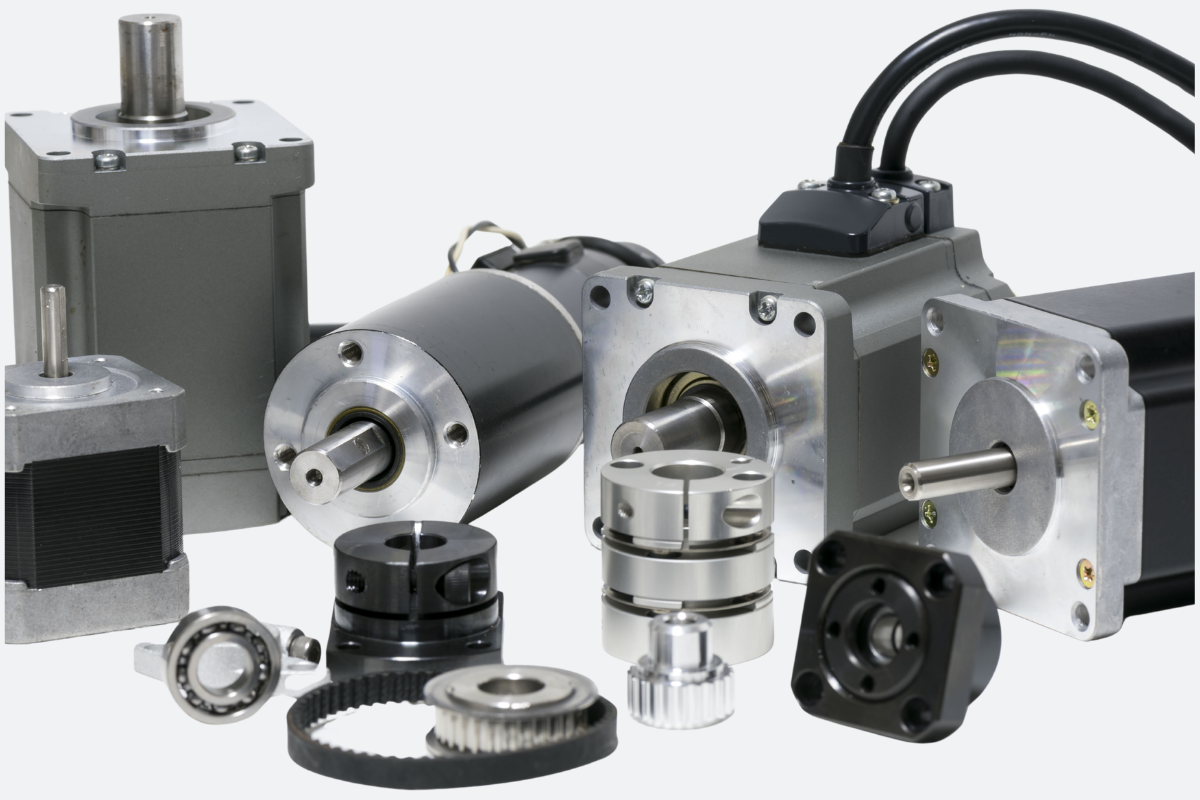
Stepper Motor vs. Servo Motor: What’s the Difference?
Quick Answer
The main difference between a stepper motor and a servo motor is how they control movement. Stepper motors move in small, precise steps and usually do not use position feedback. Servo motors, on the other hand, use feedback from an encoder to track their position and make automatic corrections if needed.
Stepper motors are often used in lower-cost projects where conditions are predictable and performance needs are moderate. Servo motors are chosen when you need higher speeds, better accuracy, synchronized movement, or more dynamic performance. Knowing the difference helps machine builders and automation professionals pick the right motor for their needs.
A quick note: In casual industry conversation, the terms “servo” and “servo motor” are often used interchangeably. While common, this can cause confusion, especially when trying to understand how they differ from stepper systems.
Technically, a “servo” describes the entire closed-loop system: the controller, the drive or amplifier, the motor, and a feedback device such as an encoder or resolver. This distinction is critical for engineers to keep in mind. Unlike a traditional stepper motor, which typically operates open-loop by executing step commands without knowing if it actually reached its destination, a servo system is defined by the feedback loop.
What Is a Stepper Motor?
A stepper motor is an electric motor that divides a full rotation into a number of equal, discrete increments. Each electrical pulse from the drive translates to a specific angular step, allowing for precise positioning. While traditional stepping can be jarring, microstepping techniques can achieve smoother rotation and higher resolution by electronically subdividing these increments, though this adds complexity to the drive electronics.
Because the controller tracks the number of pulses commanded, it operates on the assumption that the motor has reached the target position. In most standard configurations, there is no hardware feedback to verify the motor’s actual state. This architecture is known as open-loop control.
You’ll often find stepper motors in 3D printers, desktop CNC machines, lab instruments, and light-duty automation systems. When speeds are moderate and needs are simple, stepper motors offer an easy and affordable way to control motion.
What Is a Servo Motor?
A “servo motor” is simply a motor that is optimized for a servo system. At the hardware level, a servo motor is typically a brushless, permanent magnet synchronous motor characterized by a low-inertia rotor that enables rapid acceleration and deceleration. Unlike stepper motors, servo motors utilize a low magnetic pole count, allowing them to achieve significantly higher operational speeds without experiencing high-frequency torque degradation. This design yields a relatively flat torque-speed curve, meaning the motor can consistently deliver its full rated torque across its entire speed range up to its maximum rated RPM. Furthermore, these motors feature high power density, high peak torque capacity to handle transient overloads, and an integrated mechanical housing built to rigidly couple with high-resolution encoders or resolvers.
The Most Important Difference: Feedback
The biggest difference between stepper and servo motors is feedback. Traditional open-loop stepper systems assume every movement happens as planned, which usually works if the motor stays within its limits.
Servo systems use encoders to constantly report the motor’s position to the drive, so it can compare the actual and target positions in real time. If something changes or there’s resistance, the controller can spot and fix errors right away.
This feedback loop helps servo systems keep motion precise in tough applications where accuracy and reliability really matter.
Stepper Motor vs. Servo Motor: Key Differences
Position Accuracy
Both types of motors can position things accurately, but they work differently. Stepper motors move a set number of steps and assume they finish each move. Servo motors keep checking their position and can fix errors as they happen.
If conditions stay the same, both types of motors work well. But if things change or you can’t allow any positioning errors, servo motors usually have the edge.
Speed
Stepper motors provide high torque at low speeds, but they experience significant torque roll-off as speed increases. This performance drop is primarily due to physical limitations like back-EMF and winding inductance, which make it harder for the drive to push current into the motor at higher frequencies.
Servo motors maintain consistent torque across a wide speed range. They can accelerate rapidly and sustain high performance even at high RPMs. If an application requires high-velocity movement or dynamic output, a servo system is typically the superior engineering choice.
Torque Performance
Stepper motors have strong holding torque when they’re not moving, which is helpful if you need to keep something in place.
Servo motors excel when loads fluctuate during operation. Because the drive continuously adjusts power output based on feedback, the system can compensate for varying mechanical resistance to maintain the commanded trajectory.
Efficiency
Energy use matters when choosing a motor. Stepper motors often use a lot of current, even just to hold their position because they require constant current flow through the stator windings to generate a static magnetic field that locks the rotor into position..
Servo motors use power based on what the job needs and only use as much energy as needed for the motion. This often makes them more energy efficient, especially in bigger or always-running machines.
Motion Quality
Servo motors usually move more smoothly because the drive keeps adjusting performance using feedback. This reduces vibration and helps the system react better to changes.
Stepper motors can position things very well, but they might vibrate or resonate at some speeds. This isn’t always a problem, but it matters if you need smooth motion.
Initial Cost
Stepper systems usually cost less to buy and set up since they need fewer parts and simpler controls. That’s why they’re a good choice when budget is important.
Servo systems need feedback devices, more advanced drive controllers, and extra setup. They cost more at first, but the better performance can be worth it if you need high machine capability and reliability.
When Should You Use a Stepper Motor?
A stepper motor is a good choice when your motion needs are simple and conditions don’t change much. If you need moderate speeds, simple movement, and affordable positioning, stepper motors often work very well.
Many machines still use stepper motors because they balance performance and cost. If you can accept occasional positioning errors and high output isn’t your main goal, a stepper motor is often the best option.
When Should You Use a Servo Motor?
Servo motors are usually the top pick when machine performance affects productivity, quality, or output. Since they keep checking and adjusting their position, servo systems stay accurate even at high speeds or when loads change.
Packaging machines, robots, automated assembly lines, and material handling systems often use servo technology because they need more than just basic positioning. These applications need smooth motion, fast acceleration, precise coordination across several axes, and steady performance during the whole operating cycle.
If your application needs motors to work together or if uptime and production rates really matter, it’s often worth investing in servo technology.
Using BLDC Motors in Servo Systems
You may also encounter Brushless DC (BLDC) motors being used in servo control architectures, even if they aren't explicitly marketed as servo motors. In these configurations, a BLDC motor can be paired with a compatible drive to achieve closed-loop performance. Using integrated Hall-effect sensors for commutation and speed feedback can be a cost-effective way to achieve precise speed and acceleration control, making them a common choice for applications like conveyors.
However, there are important trade-offs to consider compared to dedicated servo motors. BLDC motors often have higher rotor inertia, which can limit their dynamic response compared to high-performance servo motors. Furthermore, because they do not always include high-resolution encoders, achieving the precise, fine-tuned positioning of a full-featured servo system may be difficult. Before choosing this route, it is important to confirm that the motor’s specific performance profile aligns with the dynamic demands of your application.
For many applications, this approach serves as an ideal middle ground between cost-sensitive stepper systems and high-performance servo setups. By utilizing a BLDC motor within a flexible, high-capability architecture like the InoDrive platform, you can achieve the high speeds and precise motion control typically associated with more expensive systems without the added cost of a dedicated, premium servo motor. This allows engineers to optimize their hardware budget while still meeting demanding performance requirements for speed and acceleration.
Sometimes a Stepper Motor Is the Better Choice
Even though servo technology has big performance benefits, it’s not always the best choice for every job. Many machines don’t need all the extra features a servo system offers.
If your application only needs moderate speeds, predictable conditions, and simple positioning, a stepper motor can do the job well and save money. Stepper systems are also easier to set up and can make machine design simpler.
The aim isn’t to pick the most advanced motor, but to choose the one that fits your needs best. Sometimes that’s a servo motor, but in other cases, a stepper motor is more practical and cost-effective.
Why This Difference Matters
Choosing the right motor affects how well your machine performs, how reliable it is, how much energy it uses, how much maintenance it needs, and how easy it is to upgrade later.
As machines get more advanced, precise motion control matters more. When you need several motors to speed up, slow down, and hold position together, servo technology helps because feedback keeps everything coordinated and predictable.
But that doesn’t mean servo motors are always the best answer. Many jobs still work great with stepper motors. The main thing is to know what your machine needs and pick the technology that fits those goals.
Frequently Asked Questions About Stepper Motors and Servo Motors
Is a servo motor better than a stepper motor?
Not always. Servo motors usually offer higher speeds, better efficiency, and constant position feedback. But stepper motors are a great choice for slower jobs where conditions are steady and cost matters most.
The best motor is the one that matches your application’s needs, not just the technology.
Why are servo motors more expensive than stepper motors?
Servo systems need extra parts, like encoders and advanced drives. These let the system check and fix motion errors right away, which boosts performance, reliability, and flexibility.
Even though servo systems cost more at first, many companies find them worth the investment when machine performance affects how much they can produce.
Can a stepper motor lose position?
Yes. If a stepper motor is overloaded, sped up too quickly, or faces unexpected resistance, it can miss steps. Since most stepper systems don’t use feedback, the controller might not notice a positioning error.
That’s one reason why servo systems are used when you can’t allow any positioning errors.
Are all stepper motors open-loop systems?
No. Most stepper motor systems don’t use position feedback, but there are closed-loop stepper systems too. These use feedback devices to track motor position and can work better than regular open-loop steppers.
Even with these improvements, servo motors are still the go-to choice for jobs that need high speeds, dynamic movement, and coordinated control of several axes.
Do servo motors require feedback?
Yes. A servo system depends on feedback from an encoder or similar device to track the motor’s position and speed. Without feedback, it couldn’t spot or fix motion errors.
The feedback loop is what sets servo technology apart.
Are servo motors more energy efficient than stepper motors?
In many cases, yes. Servo motors usually use power based on the work they’re doing, while stepper motors often keep drawing current even when just holding still.
The difference might be small in some cases, but it can really add up in bigger systems or machines that run all the time.
When should I upgrade from a stepper motor to a servo motor?
You might want to switch to a servo motor if you need better positioning accuracy, faster machine speeds, changing loads, or motors that have to stay in sync. Many machine builders move to servo technology as their needs and machines grow.
Can servo motors and stepper motors be used in the same machine?
Yes. Many machines use stepper motors for simple positioning and servo motors for jobs that need higher performance or coordinated movement. Picking the right motor for each part helps balance cost and performance and makes sure the machine does what it needs to.
The Bottom Line
Both stepper and servo motors play important roles in today’s automation. Neither one is always better, and both can work great when used in the right way.
The best choice depends on what your application needs, how it will run, and your business goals. Knowing the pros and cons of each motor helps machine builders and automation pros pick the right balance of performance, complexity, and cost.
Ready to Simplify Servo Motion Control?
Cardinal Kinetic’s InoWorx™ motion control platform makes motion control easier without losing performance. Whether you need to sync multiple motors, boost machine performance, or look for new motion control options, Cardinal Kinetic can help you find the right solution.
Get in touch with us to learn more.